 Mode of inheritance is the pattern or the manner in which a particular genetic trait or disease is passed from one generation to the next. Common modes of inheritance are listed below.
[yjsgacs id="inheritance"]
[yjsgacgroup title="Autosomal Recessive" active=""]
An autosomal recessive condition means that the condition is expressed in an individual with two mutant/damaged copies of the same gene (or one damaged copy from each parent). Both parents must be at least carriers to pass on the disease. Some diseases may occur in higher frequencies in certain breeds. Autosomal recessive conditions typically affect both males and females equally.
[/yjsgacgroup]
[yjsgacgroup title="Autosomal recessive/dominant inheritance with incomplete penetrance" active="0"]
Penetrance refers to the percentage of individuals with the damaged/mutant gene that show the physical feature and symptoms of the disorder. Most autosomal conditions have complete penetrance, but some diseases have incomplete (or reduced) penetrance. Incomplete penetrance is most likely a result of the way the gene interacts with other genes as well as the environment. Lastly, it may cause the disorder to look like it is “skipping” individuals or generations, while in reality it is not. Conditions with incomplete penetrance includes some diseases such as exercise induced collapse and secondary glaucoma whereby an affected animal may not show symptoms or “a low level of symptoms” until external influences force the defect to appear.
[/yjsgacgroup]
[yjsgacgroup title="Autosomal Dominant" active="0"]
An autosomal dominant condition means that the condition is expressed in individuals who have one (or possibly more) mutant/affected copy of the gene. These conditions are caused by genes that are located on chromosomes other than the sex chromosomes (X and Y). Autosomal dominant conditions typically affect both males and females equally and the condition can be inherited from either parent.
[/yjsgacgroup]
[yjsgacgroup title="Sex Linked" active="0"]
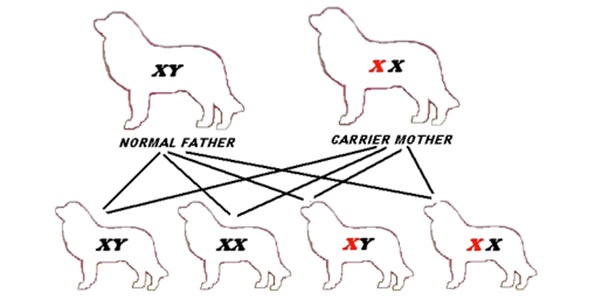
An X-linked condition results when an animal has a mutation in one of the genes on the X chromosome. X-linked conditions usually affect males more often and more severely than females. Females with a mutation in a gene on one X chromosome and a normal copy of the gene on the other X chromosome are called carriers. They are generally healthy, but they may have male offspring who are affected with the condition.
[/yjsgacgroup]
[yjsgacgroup title="Polygenetic Diseases" active="0"]
Refers to the mode of inheritance of quantitative traits. Polygenetic diseases are influenced by multiple (two or more) genes, not just one. In addition to involving multiple genes, the environment and nutrition also play a part in the development of the disease. An example of a polygenetic disease is hip dysplasia.
[/yjsgacgroup]
[/yjsgacs]